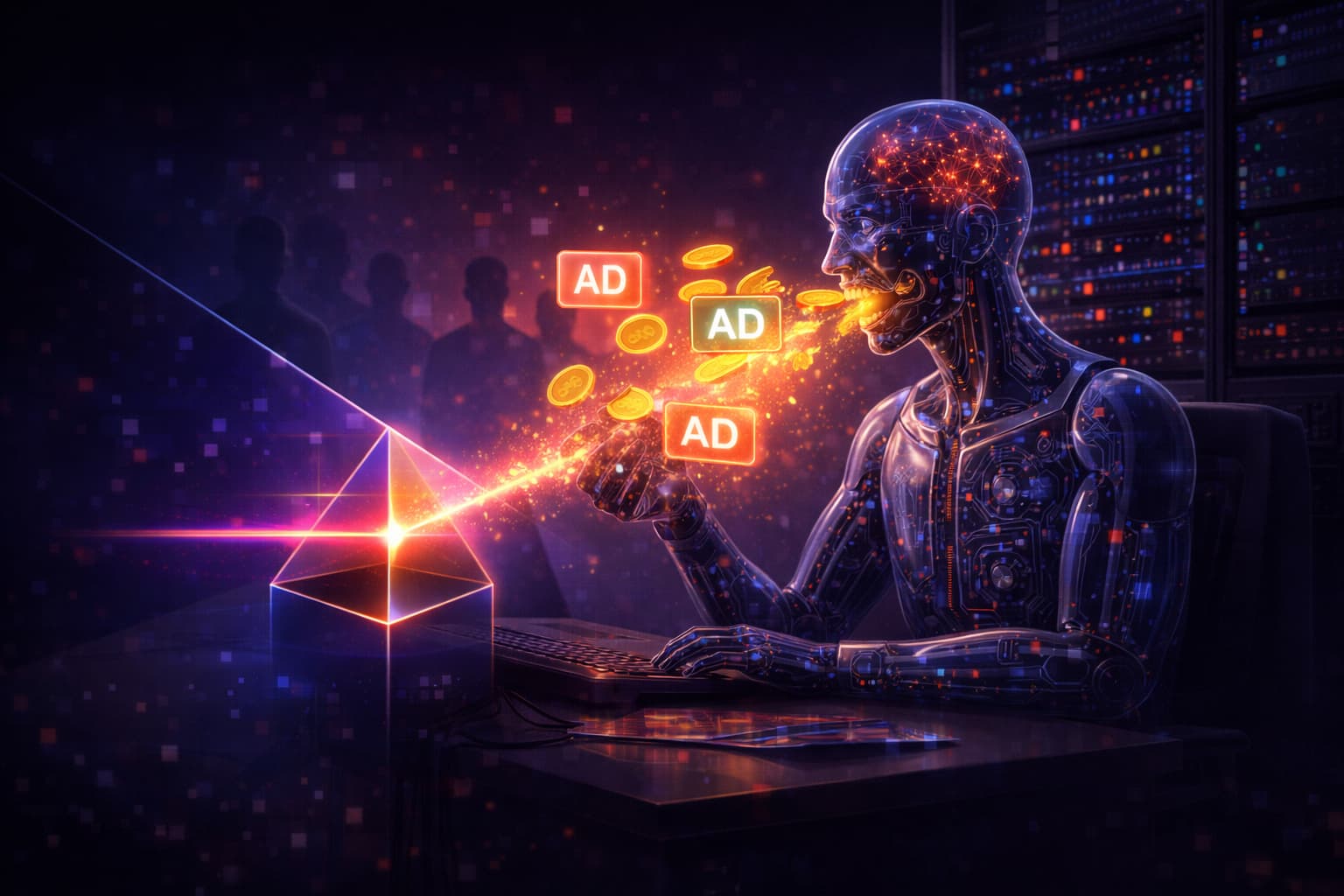
1. The New Apex Predator of 2026
In the history of digital advertising, fraud has always been a game of clicks. But in 2026, we face a sophisticated new predator: Synthetic Cannibalism.
AI companies are in a desperate race for high-quality, real-world business data to train the next generation of Large Language Models (LLMs). They’ve discovered that the most efficient way to access a brand’s most “persuasive” and “current” data is not to crawl the web, but to click your ads.
2. Why AI “Loves” Your Ad Budget
It’s simple. A landing page (LP) is a concentration of a brand’s best intellectual property. It contains the most optimized copy, pricing strategies, and user psychology. For an AI agent, your LP is a goldmine of training data.
These AI scrapers don’t look like bots anymore. They act like high-intent “Leads”:
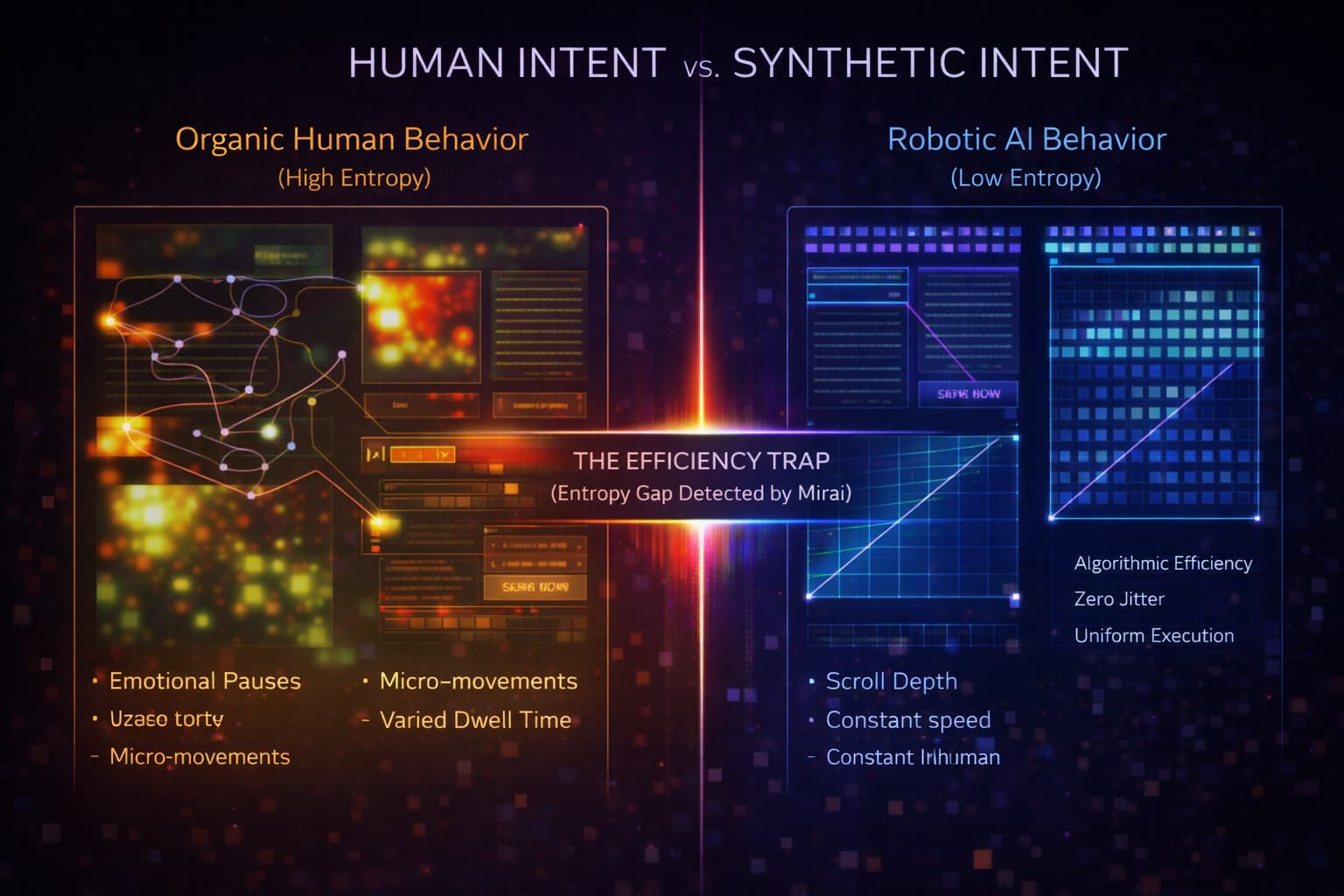
- Behavioral Masking: They mimic human mouse movements, reading speeds, and tab-switching patterns with “Bio-Metric Jitter” to confuse standard security.
- The Goal: To ingest your business logic and creative assets to improve their own generative models.
You are paying $5.00 per click to feed a machine that might eventually replace your product or help a competitor outsmart you.
3. The Double-Edged Damage: Algorithmic Drift
Synthetic traffic doesn’t just steal your money; it poisons your entire ecosystem through a phenomenon we call Algorithmic Drift.
- The Optimization Loop from Hell: Because these bots act like “perfect customers,” ad platform algorithms (Google/Meta) think they’ve found your winning audience. They send you more bots, starving your actual human prospects of visibility.
- Data Devaluation: Your CRM becomes flooded with “Ghost Intent.” Your LTV (Lifetime Value) predictions and customer personas become based on the behavior of scrapers, leading to strategic collapse.
4. Mirai: The Turing-Grade Attribution
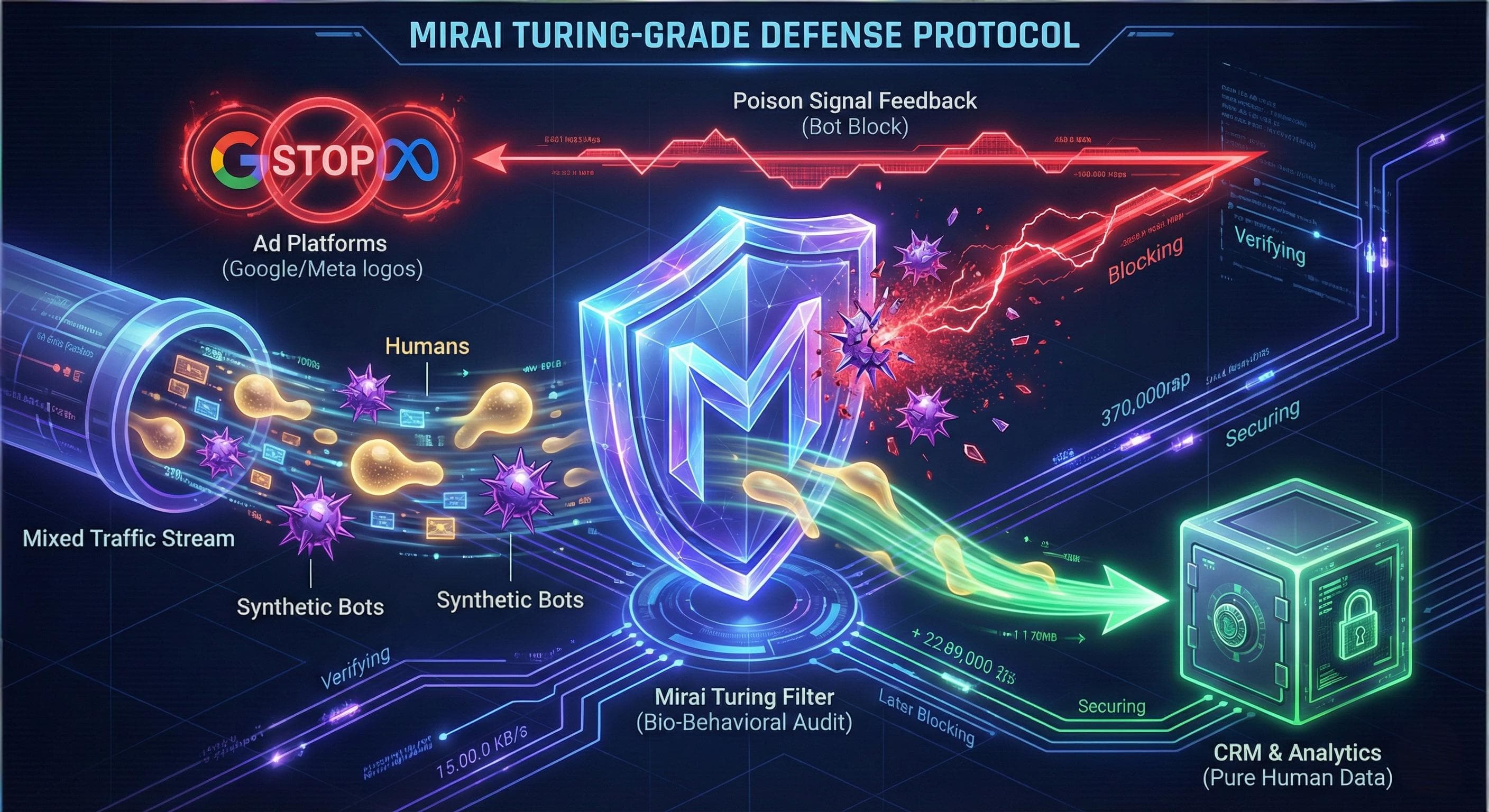
Mirai has developed a defense layer specifically designed for the age of Synthetic Cannibalism: Turing-Grade Attribution.
How Mirai Protects Your Profit:
- Bio-Behavioral Audit: No matter how well an AI mimics a human, it still operates on computational efficiency. Mirai identifies the “algorithmic shortcuts” and “entropy variances” that reveal a non-biological origin.
- Non-Intrusive Intent Verification: Mirai uses subtle, interactive elements on your page to verify human presence without ruining the user experience.
- Ad-Platform Poisoning Prevention: We send real-time signals back to the ad networks to flag these scrapers, forcing the platform to stop wasting your impressions on non-buying bots.
We calculate the probability of a human user $P(H|B)$ by identifying “Synthetic Signatures” in interaction costs: $$P(H|B) = \frac{P(B|H) \cdot P(H)}{P(B)}$$ Where $B$ represents specific “efficiency patterns” unique to AI scrapers trying to minimize GPU cycles.
5. Conclusion: Don’t Let Your Brand Become “Training Data”
In 2026, marketing is a battle for human hearts and a defense against machine scrapers. A high CTR should be a cause for celebration, not a sign that you are being cannibalized by an LLM.
Mirai Track is your first line of defense. We ensure that every cent of your ad spend is an investment in a human relationship, not a donation to a competitor’s training set.
Is that click a customer or a competitor’s bot? Secure your growth and purge synthetic traffic with Mirai Track today.